• Home
  • Berita
  • Kekuasaan Hukum dan Kekuatan Hukum: Sebuah Potret Akademik

668ca35cbc3a6-1720492892

Kekuasaan Hukum dan Kekuatan Hukum: Sebuah Potret Akademik

admin 9 Jul 2024

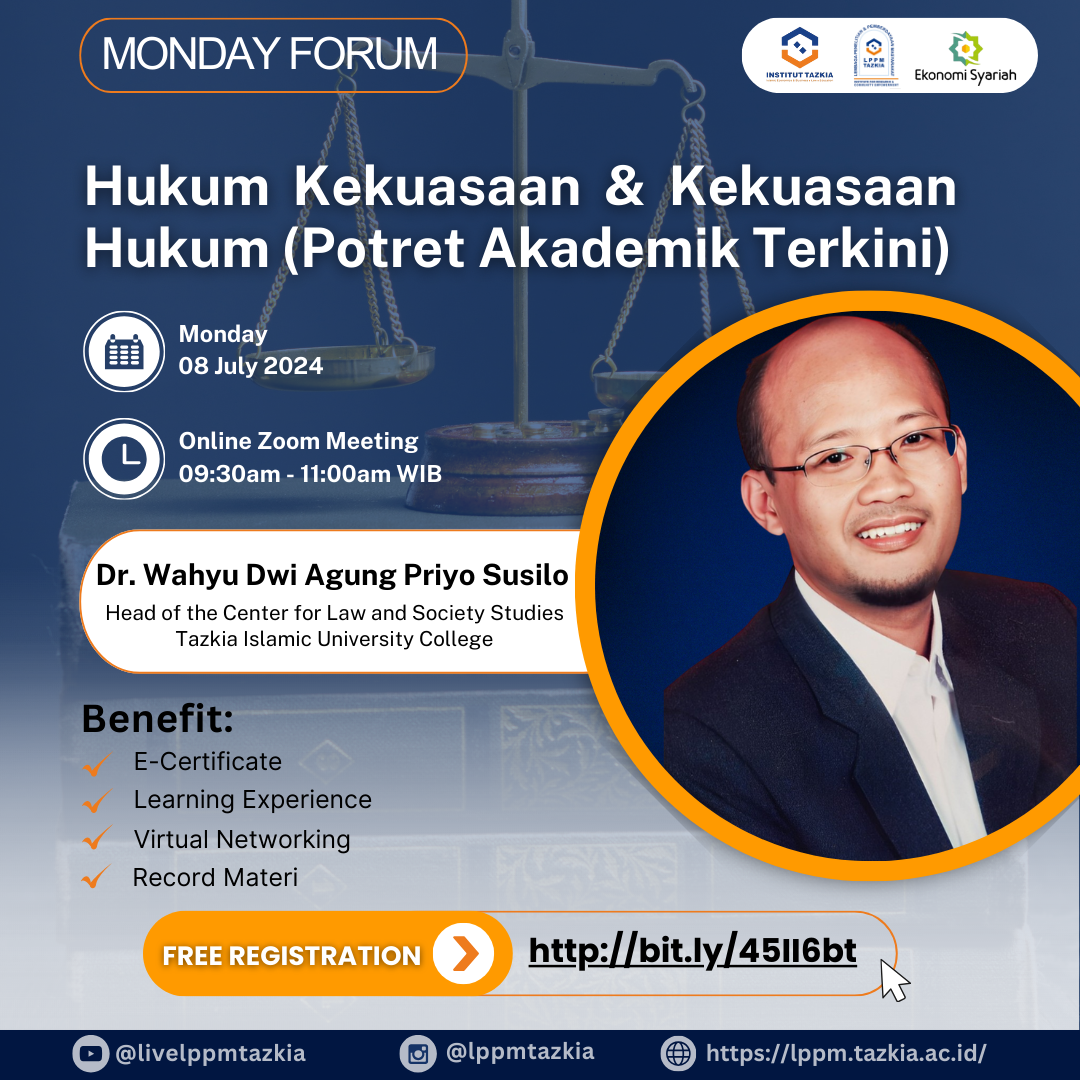
Pada sesi akademik kali ini Senin, 08 Juli 2024, kita akan membahas tema yang menarik dan relevan dengan situasi politik dan ekonomi saat ini, yaitu "Kekuasaan Hukum dan Kekuatan Hukum". Tema ini tidak hanya membuka wawasan kita mengenai hukum dan kekuasaan, tetapi juga mengajak kita untuk lebih peduli terhadap isu-isu sosial yang mempengaruhi kehidupan masyarakat. Dr. Wahyu Dwi Agung Priyo Susilo, Kepala Pusat Studi Kajian Hukum dan Masyarakat di Institut Agama Islam Tazkia, akan memaparkan pandangannya.

Pendekatan Filosofis dan Sejarah Kekuasaan

Kekuasaan selalu menjadi subjek yang menarik dalam sejarah manusia. Dari zaman Yunani dan Romawi hingga masa keemasan Majapahit, kekuasaan sering kali disandingkan dengan hukum. Sejarah mencatat bahwa di Yunani, raja dianggap sebagai perwujudan hukum itu sendiri, dengan pepatah "King can do no wrong" yang menunjukkan absolutisme kekuasaan raja. Filosofi kekuasaan ini mencerminkan bahwa tanpa kontrol hukum yang kuat, kekuasaan cenderung disalahgunakan.

Hukum sebagai Pembatas Kekuasaan

Dalam konteks hukum Islam, kekuasaan Allah adalah absolut dan tidak terbantahkan. Kisah Nabi Adam yang diusir dari surga karena melanggar perintah Allah adalah contoh kekuasaan absolut yang tidak dapat digugat. Namun, dalam dunia manusia, kekuasaan harus dibatasi oleh hukum untuk mencegah korupsi dan penyalahgunaan wewenang. Hukum, sebagai cita-cita keadilan, harus diterapkan untuk mengontrol kekuasaan dan memastikan keadilan bagi semua pihak.

Kekuasaan dan Hukum dalam Konteks Modern

Di era modern, kita melihat bahwa kekuasaan yang tidak diimbangi dengan kontrol hukum yang ketat dapat berakibat pada tindakan sewenang-wenang. Sejarah Indonesia, mulai dari masa Majapahit hingga era kemerdekaan, menunjukkan bahwa kekuasaan yang tidak terkontrol dapat berakhir dengan konflik dan ketidakadilan. Oleh karena itu, penting bagi kita untuk memahami bahwa hukum harus selalu berada di atas kekuasaan, bukan sebaliknya.

Kesimpulan

Kekuasaan dan hukum adalah dua sisi mata uang yang tidak dapat dipisahkan. Tanpa hukum yang kuat, kekuasaan cenderung absolut dan korup. Oleh karena itu, dalam setiap aspek kehidupan, kita harus memastikan bahwa hukum ditegakkan untuk membatasi kekuasaan dan melindungi hak-hak individu. Sebagai akademisi dan masyarakat yang peduli, kita harus terus mengingatkan pentingnya hukum sebagai pengontrol kekuasaan demi terciptanya keadilan dan kesejahteraan bersama.

Anda Mungkin Suka

65699d1bf1363-1701420315

Persyaratan Pengajuan Proposal OR IPSH 2024

Persyaratan Pengajuan Proposal OR IPSH 2024
1. SDM Iptek Aktif BRIN dan harus ada anggota dari OR IPSH
2. Kepakaran dan rekam jejak penelitian sesuai proposal yang diajukan
3. Satu (1) SDM Iptek maksimum hanya satu (1) proposal dalam satu skema (Ketua-anggota/ anggota-anggota)
4. Ketua/Peneliti Kepala diutamakan berpendidikan S2 (magister)
5. SDM Iptek (program degree by research BRIN) dapat mengajukan proposal
6. Empat hingga enam (4-6) orang SDM Iptek didukung multidisiplin / keahlian
7. Dianjurkan melibatkan lebih dari satu unit kerja (Pusat Riset) di BRIN
8. Penelitian yang berkolaborasi dengan peneliti asing dan peneliti/akademisi diaspora Indonesia akan diutamakan
9. Dapat melibatkan periset anggota dari luar BRIN sesuai kebutuhan kepakaran (tidak lebih dari 50% dari jumlah anggota tim)
10. Dapat menarik berbagai sumber pendanaan (multi sources funding scheme) dan / atau kemitraan pihak luar BRIN
11. Mempunyai keluaran sesuai dengan yang ditentukan.

6516a5a9dfd49-1695983017

10th International Conference of Entrepreneurial Finance

Please find attached the call for papers of the 10th International Conference of Entrepreneurial Finance CIFEMA' 2023.

Conference Theme: : Islamic Economics and Finance in  a Changing Reality : Challenges and Development Prospects

The conference will be held on 22–24 November 2023 at the National School of Trade and Management (Acronym ENCG), Ibn Zohr University, Agadir-Morocco.

Please feel free to forward this call to any researcher who may be interested.
Prof. Dr. Ahmed Chakir,
organizing committee

64c369896dcd9-1690528137

15TH INTERNATIONAL CONFERENCE ON ISLAMIC ECONOMICS AND FINANCE (15TH ICIEF)

CALL FOR PAPERS


15TH INTERNATIONAL CONFERENCE ON ISLAMIC ECONOMICS AND FINANCE (15TH ICIEF)
Tuesday 12th – Thursday 14th December 2023
Venue: Kuala Lumpur


Theme: Driving the Agenda for a Sustainable Humane Economy


ORGANISERS
Kulliyyah of Economics and Management Sciences, International Islamic University Malaysia (IIUM) &

International Association of Islamic Economics (IAIE)
 

IMPORTANT DATES
Paper contributors are advised to observe the following deadlines:
● Papers submission deadline:  15th August 2023
● Notification of acceptance of papers:  15th October 2023
● Deadline for presenters and participants registration: 15th November 2023


https://conference.iium.edu.my/icief2023/


INTRODUCTION
The First International Conference on Islamic Economics held in Makkah al-Mukarramah in 1976, was the watershed for the new discipline of ‘Islamic Economics’. Almost five decades later, the Kulliyyah of Economics and Management Sciences (KENMS) of the International Islamic University Malaysia (IIUM) is once again honoured to manage and host the 15th International Conference on Islamic Economics and Finance for the third time, tentatively to be held from the Tuesday 12 to Thursday 14 December 2023 in Kuala Lumpur. The theme of the conference is Driving the Agenda for a Sustainable Humane Economy.


Recovering from the COVID-19 pandemic, financial and economic crises coupled with challenges from climate change, provide the OIC countries an opportunity to embrace Islamic economics and finance as indigenous approaches to guide their economic policy responses. For this to happen, theoretical foundations of both Islamic economics and finance, as well as their links to policymaking and implementation need greater attention and integration. The world is complex and everything is connected to everything. Hence, proper planning is a part of developing a responsive and responsible Islamic Economics and Finance. The 15th ICIEF 2023 provides the platform for bringing together academics, researchers and policymakers from the Muslim world to discuss the challenges faced and how greater effort can be made towards achieving our preferred future.


OBJECTIVES
The teaching, research and practice of Islamic economics and finance have made tremendous strides globally over the last 50 years. The establishment of higher education institutions like the IIUM and development finance institutions like the Islamic Development Bank, respectively, have provided important avenues for practical implementation of education programs as well as increasing financing for economic and financial cooperation among OIC-member countries. It is important to plan for a sustainable humane future- one that recognises efficiency goes hand-in-hand with equity. However, in order to plan effectively, one must be aware of where we are, how we arrived here, what the challenges are, have a clear vision of where we want to go as well as a plan for the future. Development of research and practice of Islamic economics and finance requires commitment by all the stakeholders as well as the establishment of viable links between theory and policymaking by academics and policymakers.
 

Taking into account the state of the art and the direction of the fields of Islamic economics and finance, the 15th ICIEF focuses on the way forward toward developing the discipline of Islamic economics and finance and increasing their application especially in the economies of the OIC countries. Hence, the conference is devoted to not only theory development and application of the theory but also policy-related issues concerning, but not necessarily limited to, the following areas: Islamic Economics, Islamic Finance, Policy-Issues and Related areas in Sustainability, Shariah, Accounting, Management and Marketing.


Islamic Economics – Islamic economic system and Islamic economy; theoretical and policy studies to achieve sustainable humane development; historical and comparative economic studies; comparative economic models; Islamic economic thought; review articles useful as teaching materials at the university level.


Islamic Finance – emerging issues relating to sustainable Islamic finance; alternative financial and monetary systems from the Islamic perspective; Innovation, AI and FinTech; stability of Islamic financial system; risk-sharing in Islamic finance; Islamic finance infrastructure institutions.


Policy Issues and Prescriptions for the OIC countries – poverty and inequality; entrepreneurship development; micro and small enterprise development; legal, tax and regulatory frameworks from the Islamic economics perspective; Islamic monetary and fiscal policies including zakah and awqaf-based social safety-nets; economic indebtedness; the role of the IsDB in sustainable economic development; trade and cooperation among the OIC countries.


Other Related Areas – Sustainability, Maqasid al-Shariah and its relations to IEF; issues relating to Islamic accounting and its application to IEF; Islamic approaches to management and marketing; Islamic economics and finance education and research.


The following list is meant to give a more detailed picture of areas/topics:

i. Theoretical, Historical, Shariah, Maqasid al-Shariah and Institutional Aspects of Islamic Economics and Finance

ii. Poverty, Inequality, Socio-Economic Justice and Human Development in the Humane Economy: Theory and policy dimensions; Trade and Economic Cooperations

iii. Islamic Social Economy and Finance: Theory, Practice and Policy innovations; SDGs and the role of Islamic finance; country case-studies

iv. Management and Business Ethics, Entrepreneurship, Marketing, and Corporate Social Responsibility from an Islamic Perspective

v. Islamic Finance, Banking, Corporate Finance, and Capital Markets for a Sustainable Humane Economy

vi. AI, FinTech, Risk Management and Stability of the Islamic Financial Services Industry

vii. Climate change; sustainability studies; managing externalities for a sustainable humane economy

viii. Accounting, Auditing and Reporting for Good Governance; Regulatory and Legislative Landscape for a sustainable humane economy

ix. Central Banking, Monetary and Fiscal Policy Reforms for a Sustainable Humane Economy

x. Innovation, Technology and the Development of a Sustainable Humane Economy

The Organisers welcome theoretical, empirical and policy papers that will serve to evaluate the current strengths of the disciplines of Islamic economics and Islamic finance and to also chart out possible future directions. Keynote speeches as well as Panel Forums will also be organised.


LANGUAGE, PRESENTERS AND PARTICIPANTS
The conference will accept papers in both English and Arabic.
Approximately 100 papers are expected to be presented during the two days.
Approximately 250-300 participants are expected to attend the event.


SUBMISSION GUIDELINES
1.     Paper submissions must comply with the following guidelines:
● Paper must be either in English or Arabic.
● Original papers not published or submitted for other events.
● Paper must be in Microsoft Word format. Do not submit ZIP files.
● Do NOT include the authors’ names in the main submission of the paper, as papers will be subject to double-blind peer review.
● Full tentative title of the manuscript must be included on the paper.
● Abstract is required and should be between 200-250 words. Please limit the use of acronyms, abbreviations and references in the abstract.
● Keywords for the article: 3-5 keywords are sufficient.
● Referencing: we recommend the Harvard referencing system.
● Please do not submit duplicate copies of the papers.
● Please limit the number of pages to 30 or less (including references).


2.     Final Paper Submissions:
● Authors whose first drafts have been submitted before the deadline and accepted will be invited to submit final drafts of their research papers based on the peer-reviewers’ recommendations for revision.
● Selected papers presented to the Conference will be considered for possible publication in the International Journal of Economics, Management and Accounting (formerly IIUM Journal of Economics and Management, indexed by Web of Science Core Collection), Intellectual Discourse (IIUM, indexed by Scopus), and Islamic Economics Studies (IRTI) and KAAU Journal of Islamic Economics Indexed in SCOPUS. We are also working to get more journals on the list.
● Papers presented may also be selected to be published in edited volumes emanating from the Conference.


TICKETS AND HOTEL
Subject to the availability of funds, one author of selected accepted papers may be sponsored a round-trip economy class air ticket and/or hotel stay during the conference days only. The author who wishes to avail of conference sponsorship must be the corresponding author


CONFERENCE FEE AND CONTACTS
● The conference fee will be announced later.
● For more info, please visit our website at https://conference.iium.edu.my/icief2023/
● For queries, kindly e-mail the 15th ICIEF Secretariat at [email protected]


Detail Info:

https://allevents.in/kepong/15th-icief-2023/200024854757748

64acd262c8ec4-1689047650

The 9th International Islamic Monetary Economics and Finance Conference (9th IIMEFC)

The 9th International Islamic Monetary Economics and Finance Conference (9th IIMEFC)

Accelerating Digitalization in Sharia Economy and Finance for Inclusive and Sustainable Growth in the Post Pandemic Recovery"

25th – 26th October 2023 (Hybrid Mode - Online and in Person), Jakarta – Indonesia


DESCRIPTION

The 9th International Islamic Monetary Economics and Finance Conference (IIMEFC) and call for papers shall be held as part of the Indonesia Sharia Economic Festival (ISEF) 2023. This conference will cover topics published in the Journal of Islamic Monetary Economics and Finance (JIMF) year 2023 that arise from the development of the global Islamic economy in an environment of new normal and digital transformation. JIMF is an international peer-reviewed journal published quarterly by Bank Indonesia Institute which has been accepted for inclusion in SCOPUS. JIMF publishes important research contributions to a wide range of Islamic economics, monetary, and finance, including work along empirical, methodological, and theoretical lines.


OBJECTIVES

The purpose of this “Call for Papers” are 1) to serve as the avenue for some desirable areas and questions in the field of Islamic economics and finance and to list and reiterate the topics that arise from the development of the global Islamic economy in an environment of new normal and digital transformation. 2) to discuss issues with respect to strengthening the ecosystem of the Islamic economy in the new normal, within the Islamic economics and finance frameworks. The 9th International Islamic Monetary Economics and Finance Conference (9th-IIMEFC) will provide an ideal platform for dialogue and discussion among practitioners, academics, higher-degree students, researchers, as well as policymakers around the world.


THEME

The Sub themes of the-conference cover but not limited to the followings:

  • Digital Transformation and Role of Islamic Economy
  • Islamic Monetary Policy in the Post Pandemic and Digital Era
  • Islamic Financial Development and Cyber Currency
  • Islamic Economic and Finance for Inclusive and Sustainable Development
  • Integration Islamic Commercial and Social Finance in Digital Era
  • Digital Innovation in Islamic Finance
  • Islamic Entrepreneurship and the Role of Digitalization
  • Green Economy and Finance under Islamic Perspectives
  • The Islamic viewpoints on Global Talent Development in Digital Era
  • Recent Development and Innovation in Halal Industry


IMPORTANT DATES

Registration and Submission Open  : 14th March 2023

Deadline for Submission of Final Paper : 31th July 2023

Acceptance Notification of Accepted Papers : 25th September 2023

Conference Dates : 25th – 26th October 2023


SUBMISSION GUIDELINE

Keywords for the article 2 - 4 keywords are sufficient; JEL Classifications: 2 - 4

Only full papers along with the abstracts, maximum 10,000 words, should be submitted and follow a scientific approach, which include but not limited to:

Title: The title of the article should be no more than 12 words;

Introduction; Literature Review; Methodology; Results and Analysis

Conclusion and Recommendation


PUBLICATIONS

JIMF (Journal of Islamic Monetary Economics and Finance) with rewards;

Authors are recommended to follow the guideline of the respected Journal in the website.

Registration and submission of Full Paper can be done electronically through:  https://submit.confbay.com/conf/iimefc2023  


AWARDS & REWARDS

There will be Best Papers Awards with prize money


REGISTRATION FEES

Free registration

Index by : Scopus | Sinta S1


Detail Info:

https://jimf-bi.org/index.php/JIMF/announcement/view/20